Thoughts on the Analogue Method
Something I’ve loved seeing more and more of on social media (ironically enough) is people sharing their thoughts about returning to more analogue ways of living and enjoying life, and I’ve been trying to lean more into that over the last few years. Been trying to keep up with printing pictures and scrapbooking with them, to store memories off the digital space. Been trying to get back into journaling like I did in college, though sticking to it consistently is tricky. Been slowly piecing together a magazine, month by month, of 2026 so that, at the end of the year, I’ll have this creative project capturing moments and impressions from these days right now.
The analogue method of engaging with the world has, to me, more pros than cons. Unless I’m on Canva designing and playing around, it gets me away from a screen. Keeps me from too much scrolling. It scratches that itch to make, to do, and have a sweet, little project to show for it. It’s doing something now that I’m going to want later.
Analogue, too, can be putting together a puzzle or cultivating a garden or navigating somewhere by a paper map. The pros I associate with this branch of existence have so much to do with curiosity and problem-solving. Probably because I’ve been working on a new short story dealing with those two things, specifically, I’ve been thinking more about them.
One of the beauties of hobbies that don’t happen on a screen—building Lego sets, embroidering, bird watching—is that they’re low-stakes yet fun avenues by which to engage with problem-solving. When we have to use those skills at our jobs or in social dynamics or where the stakes are much higher, it can just be stressful to analyze, think critically, and act. Yet, when it comes to finding the next piece in the process or flipping through a bird book to try and identify what it was you saw out your window, it’s like you’ve created a little game for yourself. You’re allowed to get it wrong and try again without consequences. You’re allowed to consider as many angles as you want. You’re allowed to take your time.
In fact, if you don’t take your time, you’re likely to mess something up. You’re likely to make mistakes and end up with an outcome less satisfying than what you envisioned.
How often, in all this busy world, are we asked to slow down? When’s the last time you had an unexpected lull in your day and just enjoyed it, instead of wondering what you were forgetting to do? Being busy isn’t bad, but I do believe it’s better to embrace a daily rhythm that encourages less haste, less frenzied productivity.
It isn’t always easy to slow down, I understand. There are days where your job demands longer hours, your family looks to you to help with needs, and there’s x,y, and z on top of that. It doesn’t help that society’s outlook on the matter is in terms of assigning value by what you produce, so, at every turn, you’re urged to do more, start an extra side-hustle, keep up with whomever is the top influencer of the week. Or, forget society for a second, you could be like me, who often sets lofty goals because there’s so many projects I want to chip away at yet still only twenty-four hours in a day. There’s a lot of ways the voice of busyness speaks to us.
The good thing is this: carving out quiet moments, making time for your hobbies, giving yourself five minutes to breathe doesn’t have to be this big production. Because it doesn’t mean you have to set aside an hour every day to get into your model plane building set. It doesn’t mean you have to sit there at your window and watch birds for the entire morning.
Try five minutes, instead. Five minutes with your tea and the view out to the bird feeder and whatever shows up. Jot down observations on a notepad.
Try journaling one line at the end of the day to sum up what happened or how you felt. Keep your journal and a pen beside your bedside so it can be the last thing you do before you turn out the light.
Try carrying a book with you wherever you go. Read a page or two while you wait for your appointment. Read a few more on your lunch break or in the after-school pick-up lane, instead of being on your phone.
If there are hobbies and things you want to do that require more time, try mapping out your weekly or monthly schedule to accommodate an afternoon specifically reserved for it. And then, when that day rolls around, stick to it and do that thing. Don’t dismiss it because you’re tired or it’s easy to say you’ll get around to it later. When we start taking our joy and our rest seriously, that’s when we start paying more attention to and spending the time on the things that bring us it.
Because here’s the biggest thing about the analogue method: it connects us to this great, wide world in more profound ways than any digital platform can. It’s asking you to notice, to think, to engage.
The internet’s not going anywhere. Your access to online entertainment, socializing, and news isn’t budging. But the world is spinning, changing, every day. Your thoughts and observations are new to you. There are paths you haven’t yet taken and recipes you haven’t yet tried and little projects you’ve been thinking about doing that you haven’t yet done. What’s more, I don’t think anyone’s ever regretted the time they spent stepping away from their phone or slowing down or taking their time.
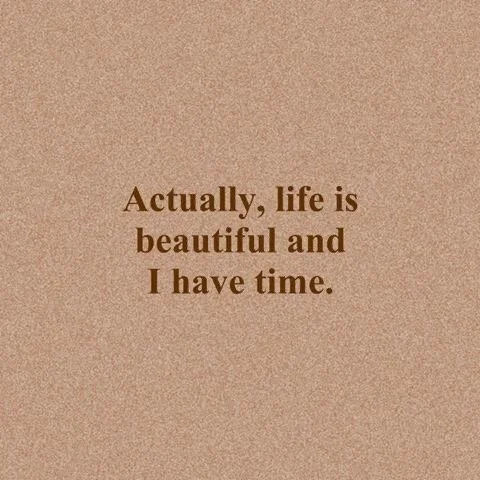
There are a few quotes I like to keep pinned to my bulletin boards that are usually near my desk, and one of them says, “Actually, life is beautiful and I have time.” It’s true life is also busy, but, if I have the time to take advantage of these analogue ways of being, then I gotta do it. And I hope, my friend, that you do, too.